
ADHD & executive function
Habit Tracking When You Have ADHD
Rigid daily trackers collide with uneven energy, real friction around starting, and all-or-nothing thinking. A few changes make consistency easier to sustain.
Updated
The short answer
Streak-based trackers tend to work against ADHD brains for three reasons: all-or-nothing thinking turns one missed day into total failure, daily schedules assume a consistency of energy and focus that does not hold, and every extra tap between intending to log and logging is a chance to lose the thread. Tracking elapsed time rather than streaks removes the failure state, and logging from a widget, Siri, or an NFC tag removes most of the friction.
Most habit trackers are built around the same assumptions: do the thing every day, don't break the chain, watch the streak grow. For a lot of people, that's motivating. For a lot of ADHD brains, it's a setup for the exact cycle that makes habits so hard to keep: a burst of enthusiasm, a missed day, a feeling of "well, I've ruined it," and then quietly abandoning the whole thing.
This is general, practical advice based on common experience, not medical guidance. ADHD affects everyone differently, and if you're managing medication or a clinical routine, please work with a healthcare professional rather than relying on any app as your sole record.
Why the usual approach fights you
A few patterns come up often when rigid trackers meet inconsistent executive function:
- All-or-nothing thinking meets an all-or-nothing tool. A broken streak doesn't feel like "one off day." It can feel like total failure, which makes it easier to quit than to keep going with an imperfect record.
- Energy and focus aren't consistent day to day, but a daily streak treats every day as identical. A schedule that assumes uniform capacity will eventually collide with a day you don't have it.
- Friction is the real enemy. If logging a habit means unlocking your phone, finding an app, and tapping through a few screens, that's often enough friction to skip it, not because the habit doesn't matter, but because the extra steps compete with everything else pulling at your attention in that moment.
- Notification fatigue is real. A constant stream of daily reminders tends to get swiped away on autopilot after the first week, which makes them useless right when you'd actually need one.
What tends to work better
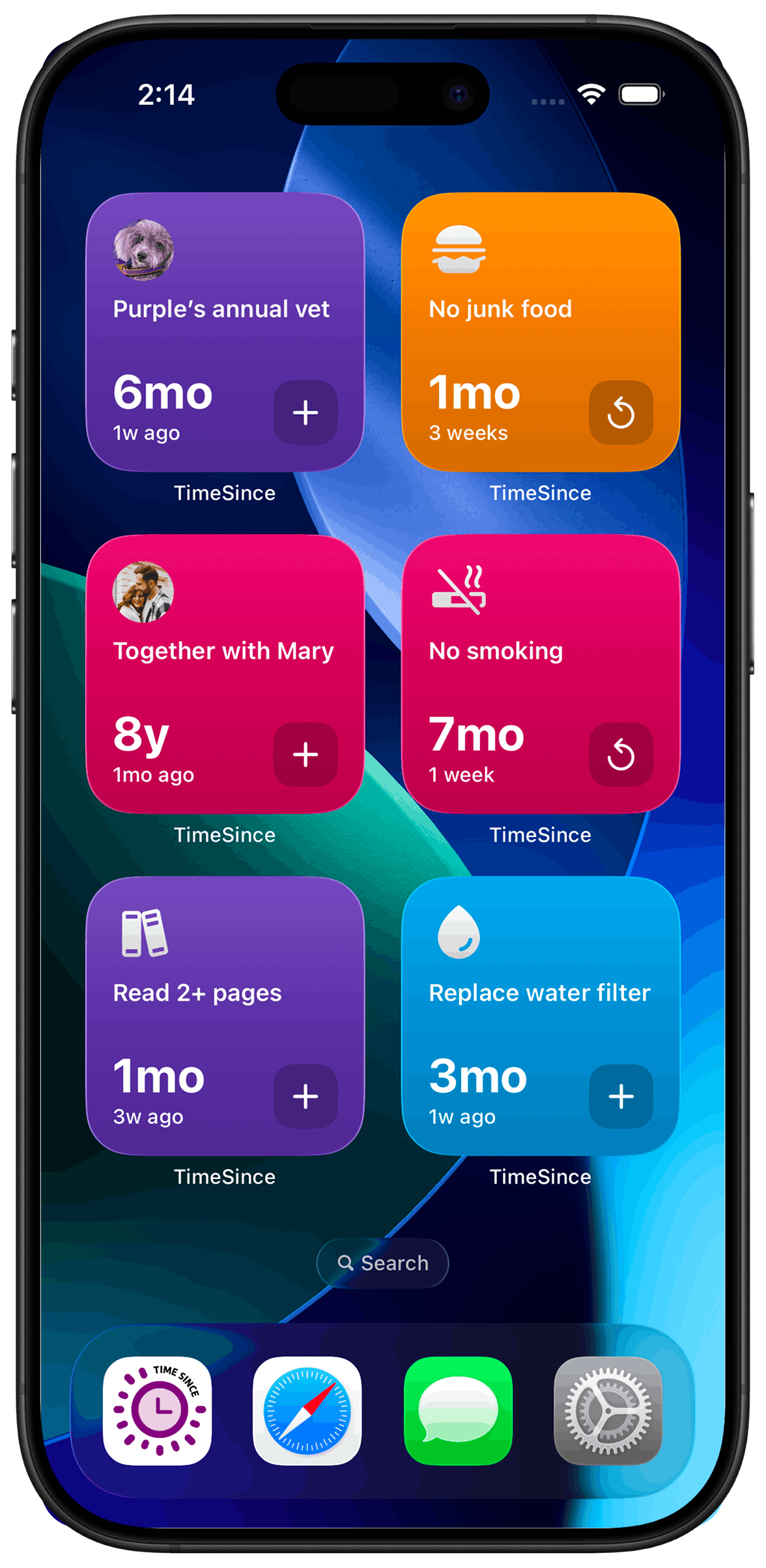
Track elapsed time, not streaks. If the number just shows "it's been 6 days" instead of demanding an unbroken chain, a bad stretch doesn't erase your progress or give you a reason to quit. You can pick the habit back up on day 6 exactly as easily as on day 1.
Cut the steps between "I want to log this" and "it's logged." The fewer taps, screens, and app-launches involved, the more likely it actually happens in the moment instead of becoming a "I'll do it later" that never comes. A home-screen widget you tap once, or telling Siri out loud, removes almost all of that friction.
Keep the list short. Tracking twelve habits at once usually means tracking zero of them well. Two or three that actually matter, tracked consistently, beats a long list that becomes background noise.
Let the number be the reward, not the pressure. A big, visible "it's been 14 days" can be a genuinely satisfying thing to look at (a small dopamine hit for something you're already doing) instead of a countdown to inevitable disappointment.
A gentler shape for consistency
None of this requires a fundamentally different habit, just a tracking model that matches how ADHD brains actually operate day to day: unevenly, with real friction around starting, and a tendency to abandon anything that's already "failed." A counter that simply climbs while you're going and restarts without judgment when you slip removes the parts of habit tracking that were never actually about the habit. They were about maintaining a perfect record. Drop that requirement, and what's left is just an honest, low-pressure way to see your own progress.
Frequently asked questions
Why do streaks feel worse with ADHD?+
A broken streak can read as total failure rather than one off day, which makes quitting feel easier than continuing with an imperfect record. Removing the streak removes the failure state that triggers the cycle.
How many habits should I track at once?+
Two or three. Tracking twelve usually means tracking none of them well, because the list stops being something you look at and becomes background noise you scroll past.
Can an app replace a medication routine?+
No. An app is a record, not a clinical system. If you are managing medication or a treatment routine, work with a healthcare professional and treat any tracker as a supplement to their guidance.
What this is based on
- Attention-Deficit/Hyperactivity Disorder (ADHD) — National Institute of Mental Health
- About ADHD: Overview — CHADD
This is educational information, not medical, legal, or financial advice. For anything affecting your health or safety, talk to a professional.
Track it without the guilt trip
TimeSince counts the time since you last did something. No streaks to break.
